What is a risk manager?
What does a risk manager do? I cannot tell you how many times I hear
these questions when I tell someone what I do for a living. Almost
without fail during social situations, the subject of one’s chosen
profession comes up. When the response is a doctor, lawyer,
accountant or a schoolteacher, the answer is self-explanatory. What
happened to risk manager?
While our chosen
profession is one that has been around awhile, it is still
trying to find itself. To further confuse things, the
banking industry has adopted the term risk manager to
describe someone who deals in financial risk, most often on
the lending side.
As President of
the Chapter, I have had the pleasure to speak to many
executive recruiters this year. Just before I give them
Becky Smith’s contact information as our placement director,
I ask about the position. This is not because I am seeking
employment; it is because I am curious as to the job
descriptions that run the gamut. The only thing I know is I
have never seen two job descriptions that are the same. With
each position comes a different set of responsibilities.
Our risk
management members have diverse responsibilities. They
report to different managers depending on the corporate
structure. Some risk managers deal solely in insurance. Some
have insurance as a minority responsibility. Today's risk
manager can have responsibility for insurance, safety,
security, transportation, facilities, environmental, and the
list goes on. Today's risk manger might report to the
treasurer, CFO, CEO, human resources, or finance director.
Today’s risk manager might be a manager, as the title
implies, or might be the Director of Risk Management, or the
VP of Risk Management, or even the CRO, the Chief Risk
Officer. Whatever your title or responsibilities are, we
must promote our profession.
I do not know
too many of us who started out wanting to be a risk manager.
There are some, however most of us ended up here through
opportunity and chance. Now there are undergrad and graduate
degrees in risk management, where the next generation can
receive a degree and hit the ground running. This all brings
me to the point of this message. We as a collective group
must get the word out about what we do. RIMS National is
working tirelessly on this message. Ellen Vinck, our
National President, is on a speaking tour that would rival a
national political figure. When you are given the
opportunity to describe your job, take a moment and promote
our profession. Collectively we can get the word out. I look
forward to the day when I am asked what I do and my response
is met with an acknowledgement of what it is we do for a
living.
Dennis
Healy
L.A. RIMS
Chapter President
Chapter Clips
Important
Notice “Blocking Your Cell Phone Number"
Many
of our members may have already heard that your cell phone service
provider is considering selling/giving your cell phone number out to
telemarketers, beginning in September 2005. To verify, you might
want to contact your cell phone service provider.
If you do not wish for your
phone number to be given out, you can prevent this by
calling 888 382-1222. The national DO NOT CALL REGISTRY is
brought to you by the California Attorney General and the
Federal Trade Commission. You may also use their website at
www.Donotcall.gov.
Once you call from your
cell phone number, it will be effective immediately and will
stay in place for 5-years.
Health & Safety
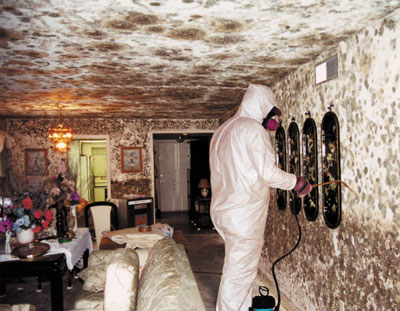
Mold Guidelines Now Available
New
training guidelines are available to protect maintenance and other
employees exposed to mold. In the absence of federal regulations,
the National Institute of Environmental Health Sciences (NIEHS) has
developed Guidelines for the Protection and Training of Workers
Engaged in Maintenance and Remediation Work Associated with Mold.
NIEHS urges trainers to follow basic principles, including:
Remove fungal damage in buildings and address the underlying
causes.
Provide respiratory protection and training, with NIOSH-approved
N-95 disposable respirators as a minimum level of protection.
Base personal protection on specific tasks that increase mold
exposure, not on measured exposure levels.
To
obtain the guidelines, visit
http://www.niehs.nih.gov
NIEHS is an agency of the National Institutes of Health.
Jump-Starting a Defibrillator Program
Each
year, there are 325,000 victims of sudden cardiac arrest (SCA),
or ventricular fibrillation in this country, according to
the Heart Rhythm Foundation. About 95 percent of them die
before they reach a hospital, and some 10,000 of the
fatalities occur at work. Without medical intervention, a
victim will collapse, lose consciousness, and die.
Automated
external defibrillators (AEDs) can dramatically improve
survival rates of victims of sudden cardiac arrest. They
work by electrically shocking a heart that is beating
abnormally back to a normal rhythm. Employers are weighing
the benefits of providing workplace AEDs.
Read on to learn
what’s involved and how investing in an AED could save a
life at your place of business.
Downloadable Software Addresses Terrorist Building Threats
Risk assessment software to
help building owners and managers guard against terrorist
threats to their facilities has been developed by the
National Institute of Standards and Technology (NIST).
The software uses a
three-step process for developing a risk-mitigation plan.
It helps users look at possible damage scenarios and explore
strategies to reduce vulnerability, such as engineering
alternatives and management practices.
It also helps evaluate the
costs of possible mitigation strategies and determine which
is most cost-effective.
“Recent Developments and Overlooked Coverages” Presented by:
Kirk
Pasich
Kirk Pasich will discuss
recent court decisions & legislative developments
(including TRIA), and the opportunities and
challenges they present for insurance coverage. He
also will address new arguments to maximize coverage
for various risks, including wage-hour claims,
electronic security claims and losses, and mergers
and acquisitions.
Mr. Pasich is a
founding partner of the Los Angeles office of
Dickstein Shapiro Morin & Oshinsky LLP. He was
named by American Lawyer as one of the top 45
lawyers in the country under the age of 45, by
California Law Business to its “Legal Dream Team”
and as one of California’s top 25 litigators, and by
Chambers USA: America’s Leading Business Lawyers
2003-04 as “the market leader for policyholder
representation in California.”
October
19, 2005 Education Day Conference Continuing Education Credits
Education Day offers the opportunity to acquire continuing
education credits for State of California licensed insurance
agents/brokers. Individuals can earn up to three hours of
credit by attending the sessions.
Venue:
The New Otani Hotel
Timings:
Registration: 7:30 am – 8:30 am
Program: 8:30 am – 1:30 pm
Registration Fees:
$100 Early Registration by Oct. 14th $115 Walk-In
Registration
$45 Lunch Only
November 7 - 8, 2005
LA RIMS Fellow Workshops Disaster Planning/Business
Continuity Planning and Management
Managing the Disaster
Attend the workshop and learn the elements of a disaster
plan and the principles of contingency planning and bring
new skills, including media management and product recall,
back to the workplace. You will learn all the aspects of how
to plan for a quick recovery when a disaster happens.
Workshop credit towards the RIMS Fellow designation is being
given for participation in this workshop by RIMS.
Individuals may attend the workshop without working toward
the designation.
The California
Building Standards Commission voted earlier this spring to
rescind its July 2003 decision to use the National Fire
Protection Association (NFPA) Uniform Fire Code as the basis
for the California Building Code and California Fire Code.
This will allow
state agencies to adopt various codes, including the
International Building Code and the International Fire Code,
in updating state building codes. The agencies will bring
proposed code amendments back to the commission for approval
and a public hearing process will follow. Final adoption of
new codes is expected to take about two years
OSHA Could
Require Injury Log For All Workers
A potential new
wrinkle in OSHA recordkeeping regs:
Proposed legislation would require “site-controlling”
employers to keep a site log of injuries and illnesses for
all employees, whether they’re employed directly, working
for contractors or temporary or leased workers.
“Site-controlling” employers have primary control over the
work site and supervise workers on a day-to-day basis, even
if they’re not direct employees.
Avoiding the Risks Of
Drowsy Driving
Vehicle wrecks
involving drowsy drivers cost an estimated $12.5 billion
each year, experts say – and the real figure is probably
much higher. That’s why the National Highway Traffic Safety
Administration (NHTSA) and AAA are trying to raise awareness
of the problem.
For a free
brochure helping drivers – whether it’s drivers on your
payroll or commuters – understand the risks and symptoms of
being drowsy behind the wheel, go to:
Good news:
Workers can wear contact lenses while working with hazardous
chemicals – as long as safety guidelines are
followed.Previously, the National Institute for Occupational
Safety and Health (NIOSH( has said employees shouldn’t wear
contact lenses while working with chemicals that can
irritate eyes or cause an injury hazard.


 Dennis Healy